

Rake, Bag, or Mulch Your Leaves This Fall? What Norwich Lawns Actually Need
Hey everyone, Steve Bousquet here with American Landscape & Lawn Science. I came across a solid video from Ryan Knorr Lawn Care recently that covers two questions I get asked constantly this time of year: what to do with all the leaves, and how low to cut the grass before winter. He explains the general idea well. But here in Norwich, with the amount of mature tree canopy we’ve got in a lot of these older neighborhoods, the leaf side of things especially plays out a little differently than it might for a lawn with just a tree or two.
Video and screenshots are used for commentary and educational purposes. Ryan Knorr Lawn Care is not affiliated with or endorsing American Landscape & Lawn Science.
After more than 41 years working on lawns around Norwich, Franklin, Lisbon, and Preston, I can tell you the two questions in that video, leaves and last mow height, come up in almost every conversation I have with homeowners from mid-October through November. So let’s break down what actually applies to our yards here.
Why Fall Cleanup Looks Different Here in Norwich
Norwich is a historic city with a lot of mature trees, oaks and maples especially, in the older established neighborhoods near Mohegan Park and throughout the surrounding area. That means fall leaf drop here tends to be heavier and lasts longer than in a newer development with young, smaller trees. Franklin, Lisbon, and Preston deal with a similar situation given the amount of tree cover in this part of Eastern Connecticut.
That heavier leaf load changes the calculation a little. Mulching leaves back into the lawn works great, and it’s genuinely less work than raking and bagging everything. But it only works if you stay ahead of it, which takes a bit more attention on a property with a lot of canopy overhead.
Mulching Leaves Back Into Norwich Lawns
If your mower can handle it, running over a normal layer of leaves and letting the chopped-up pieces settle back into the lawn is the easier path, and it puts organic material back into the soil instead of sending it off in bags. I’ve recommended this to plenty of Norwich homeowners who were spending entire weekends raking, and once they get ahead of it, it really does save a lot of time.
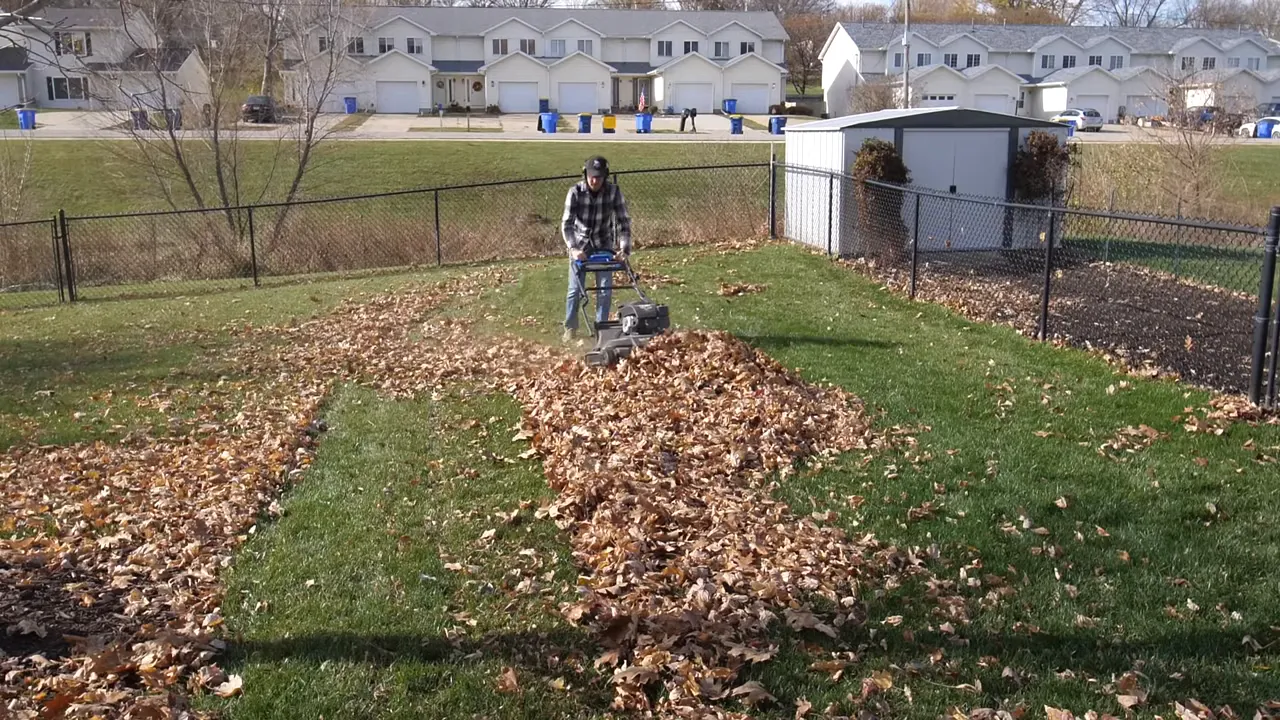
Staying ahead of leaf drop makes it much easier for a mulching mower to break leaves down.
When Norwich Yards Have Too Many Leaves to Mulch
This is where our heavier tree canopy makes a real difference. On a lawn under two or three big old oaks, the leaves can build up faster than a single mowing pass can handle, especially during a windy week in late October. I’ve seen this happen hundreds of times, someone waits for “all the leaves to be down” before dealing with them at all, and by then it’s a thick, matted layer that a mower just can’t chop up properly.
The better approach for a heavily wooded Norwich property is to mow more often while leaves are actively falling, even if that means cutting grass that doesn’t strictly need it yet, and making a second pass over any thicker sections. That keeps the leaf layer at a manageable thickness instead of letting it get away from you.
And if a storm knocks down a big batch all at once, or you’ve been out of town for a week and come back to a yard that’s buried, it’s fine to rake off the worst of it first and then mulch what’s left on a lighter pass. The goal isn’t to be rigid about one method, it’s to keep as much organic material working its way back into your soil as you reasonably can without smothering the grass underneath it.
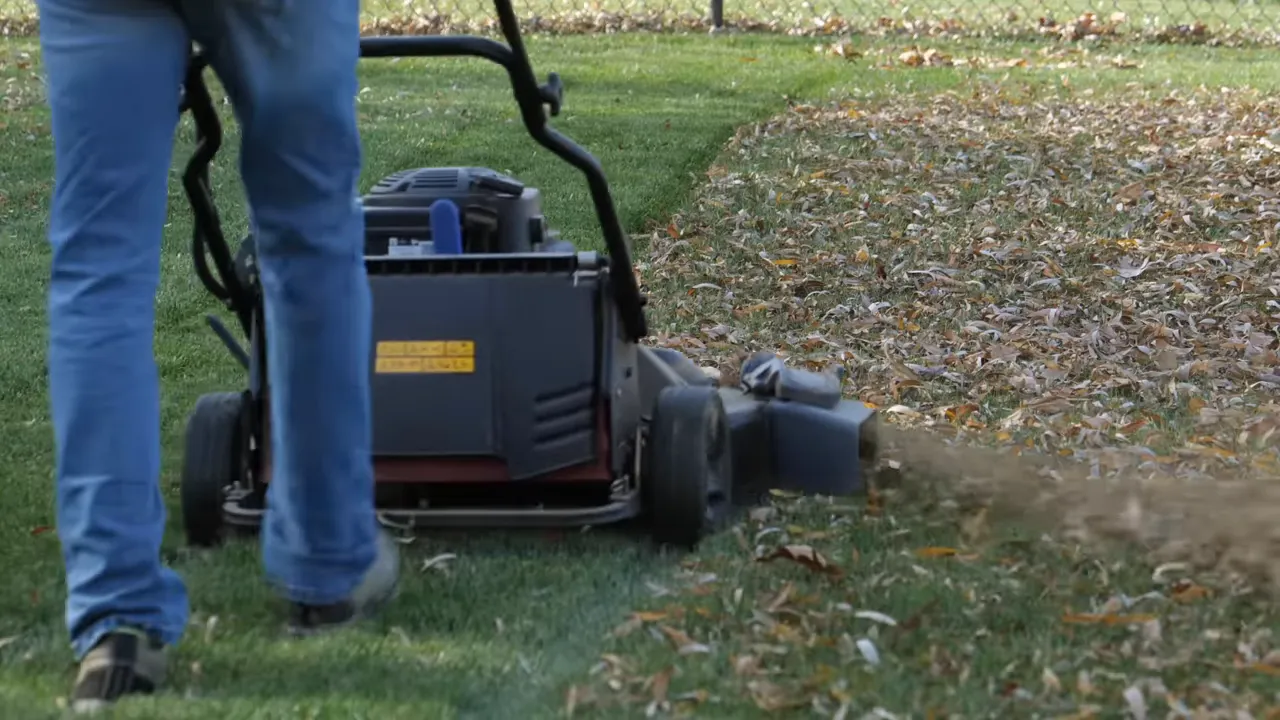
How Low Should You Cut Before Winter in Norwich?
The other question I get a lot is whether to scalp the lawn down low before winter hits. For our cool-season grass here, the answer is no. Cutting a healthy lawn down to almost nothing right before a hard freeze just adds stress at exactly the wrong time.
A good rule for Norwich lawns is to lower your final cut by no more than about a quarter to a half inch from whatever height you’ve kept all season. If you’ve been mowing around 3 inches, dropping down to somewhere around 2.5 to 2.75 inches for that last cut is plenty. You want the lawn tidy enough that long grass doesn’t mat down under snow, which can contribute to snow mold, but not so short that you’re removing more leaf blade than the grass can handle heading into a New England winter.
Common Mistakes I See Norwich Homeowners Make Every Fall
A few patterns show up again and again on properties I’ve worked on around Norwich and the surrounding towns:
Letting leaves pile up for weeks before dealing with them at all, which turns an easy mulching job into a raking project.
Cutting the grass drastically short for the last mow of the season, thinking it will somehow help the lawn through winter. It usually doesn’t, and it can add unnecessary stress.
Stopping mowing too early in fall. Cool-season grass here often keeps growing well into late October, and skipping mows too soon just lets leaves and grass both get ahead of you.
Ignoring the mower’s limits. A standard rotary mower without a mulching blade or setup can only handle so much at once. Pushing it through a deep, wet layer of leaves usually just leaves clumps sitting on top of the grass instead of breaking them down, which can smother patches of lawn if left there through winter.
A Simple End-of-Season Checklist for Your Norwich Lawn
- Keep mowing as long as the grass is actively growing, even into late fall
- Mulch leaves back into the lawn while the layer is still manageable
- On heavily wooded properties, mow more often during peak leaf drop rather than waiting
- Lower your final cut by no more than a quarter to a half inch from your normal height
- Skip the urge to scalp the lawn before winter, it doesn’t prevent snow mold and can add stress
Here to Help With Your Norwich Lawn
We’ve been caring for lawns in Norwich, Franklin, Lisbon, and Preston for more than 41 years now, working with over 3,000 active clients across Eastern Connecticut and backed by more than 100 five-star reviews. If you’d rather have a professional lawn care team handle the season-end details, or you want a hand figuring out the right plan for your yard, give us a call at 860-887-2344 or visit lawnscience.com and we’ll get you set up.
Follow Us for More Lawn Care Tips
Get FREE Grub Control
when you sign up for our 5-Step Lawn Care Program.
